|
LANGUAGES & RELIGION
Languages:
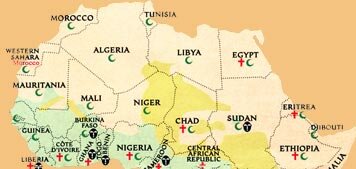
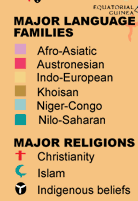
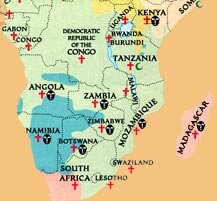
More than 1,000 different languages are spoken in Africa. Although most countries in Eastern and Southern Africa have adopted colonial European languages for official government business, most people speak indigenous or local languages.
In Namibia, people may speak English, Afrikaans, German, Oshivambo, Herero, or Nama. In Tanzania, people can speak English or Swahili.
Due to their colonial pasts, the majority of the countries in West Africa have adopted French, English, Spanish, or Portuguese as national languages. The majority of each countries' inhabitants, however, also speak one or more indigenous languages. Cameroonians may speak one or more of 24 different languages, in addition to French or English.
|
 |
|
|
Yoruba, Hause, and Igbo are some of the nearly 400 native languages of Nigeria.
Most people in the North African countries speak Arabic and follow Islam. In some parts of North Africa, however, people are multilingual and speak several languages. For example, the official languages of Chad and Djibouti are Arabic and French.
In Ethiopia, people may speak one or more of 70 unique languages or 200 different dialects. A dialect is a form or variety of a spoken language.
Religion:
Most people in the fourteen independent countries in North Africa are Muslim. The religion they believe in is called Islam. Muslims pray to their god Allah and his prophet Muhammad five times a day facing the city of Mecca. A prophet is someone who is believed to speak for a god. The Koran is the Muslim holy book.
In African countries south of the Sahara Desert, people follow many different religions. Some are Muslim, although the majority of the people are Christian. Missionaries from other parts of the world brought Christianity to many countries in Africa. Some people, however, choose to follow ancient religions and believe that natural spirits and ancestors affect everyday life.
|
|